 ChatGPT
 Perplexity
 Grok
 Google AI
Manual lead qualification can drain valuable time from the sales team. Sales teams often spend hours reviewing individual leads. This delays responses and can cause valuable opportunities to disappear. It also leads to inconsistent decisions among team members. These challenges make traditional qualification difficult to manage at scale.
AI lead qualification offers a smarter approach for businesses. It analyses lead data and identifies important buying signals. It can also rank prospects based on their potential.
But can AI completely replace traditional lead qualification? Or should businesses use AI alongside experienced sales teams? This article explores both approaches and their key differences. It also explains where human judgement still matters.
What Is Traditional Lead Qualification?
Traditional lead qualification relies heavily on human review. Sales teams assess leads using different information sources. They review forms, emails, calls, and website activity. Teams then compare leads against their ideal customer profile.
They also assess needs, budgets, and purchase readiness. Sales representatives may contact prospects for further information. This process helps teams identify promising sales opportunities.
However, traditional qualification depends heavily on human judgement. Experienced salespeople can recognise valuable opportunities quickly. They can understand context that data may overlook.
Yet different representatives may reach different conclusions. This can create inconsistent qualification across sales teams. Manual processes also become more difficult as lead volumes grow.
How Manual Lead Qualification Works
Sales teams first review the information each lead provides. They examine names, roles, companies, and contact details. They then check each prospect’s buying intent. This helps teams understand genuine levels of interest. Sales teams also assess each lead’s overall business fit. They consider needs, budgets, goals, and purchase readiness. Qualified leads then move towards the sales team.
Limitations of Manual Lead Qualification
Manual qualification requires considerable time from sales teams. Teams must review every lead before making decisions. Human judgement can also vary between different team members.
This variation can create inconsistent qualification results. Manual processes also struggle with large lead volumes. Sales teams may miss promising leads during busy periods.
What Is AI Lead Qualification?
AI lead qualification uses technology to assess potential customers. It processes lead information much faster than humans. AI systems analyse behaviour, interactions, and other available data. They then identify patterns linked with buying interest. This helps sales teams prioritise promising prospects more efficiently.
How AI Qualifies Leads
AI analyses how prospects interact with business channels. It can track website visits and content engagement. It can also identify repeated interactions with key pages. These actions can reveal stronger buying signals. AI evaluates this information alongside existing lead data. It then ranks prospects according to their potential value.
AI Lead Scoring Explained
AI lead scoring assigns scores to individual prospects. These scores reflect each lead’s likelihood of conversion. AI lead scoring can consider multiple behavioural signals. Predictive lead scoring takes this process further. It uses historical patterns to identify likely future outcomes.
Sales teams can then focus on higher-value opportunities. Lead scoring automation also reduces repetitive qualification work. Explore Using AI to Prioritise High-Quality Leads to improve lead prioritisation with AI.
AI Lead Qualification vs Manual Lead Qualification
AI and manual qualification follow very different approaches. Manual methods depend mainly on human assessment. AI uses data, patterns, and automated scoring. Both approaches offer different strengths for sales teams. The right choice depends on business needs.
Speed and Efficiency
Manual qualification requires salespeople to review leads individually. This process can take considerable time each day. AI can process large volumes of leads quickly. Automation can assess multiple prospects simultaneously. This allows sales teams to respond faster. It also reduces repetitive qualification tasks for representatives.
Accuracy and Consistency
Manual qualification depends on individual experience and judgement. Different representatives may assess similar leads differently. This can create inconsistent qualification across sales teams.
AI applies consistent rules across available lead data. Data-driven scoring can reduce variation between assessments. However, AI accuracy depends on quality data. Poor information can still produce unreliable results.
Personalisation and Context
Human representatives understand conversations and individual customer situations. They can recognise concerns that data may not show. They can also ask questions and clarify specific needs.
AI can identify patterns across many customer interactions. However, it may miss important personal context. Sales teams can therefore add valuable human understanding.
Scalability
Manual qualification becomes harder as the number of leads increases. Sales teams need more time for additional prospects. AI can process large volumes without increasing workloads. Lead scoring automation helps prioritise prospects automatically. Teams can then focus on the strongest opportunities. This makes AI useful for growing sales operations.
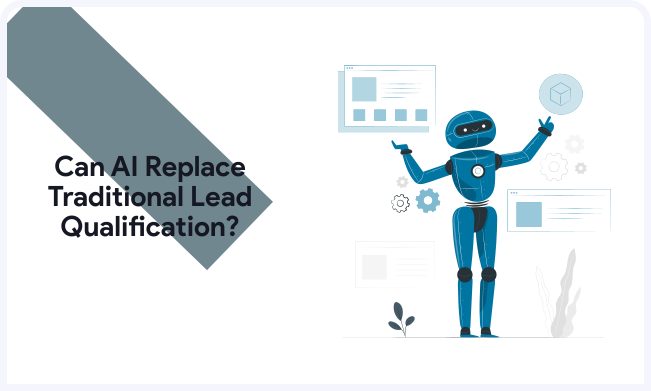
Can AI Completely Replace Traditional Lead Qualification?
AI can replace many repetitive qualification tasks. However, complete replacement remains impractical for many businesses. AI works well with large and structured datasets. It can quickly identify patterns and prioritise promising prospects.
Yet some leads require deeper human understanding. Complex needs may require conversations with experienced salespeople.
Human judgement remains valuable during important sales decisions. Representatives can assess unusual situations and specific concerns. They can also build trust through direct conversations.
A combined approach can therefore deliver stronger results. AI handles repetitive work while people provide context. This approach improves efficiency without removing human judgement.
The Best Approach: AI and Human Qualification Together
AI and human expertise work well together. AI can efficiently manage repetitive qualification tasks. Sales teams can then focus on complex opportunities. This approach balances speed, consistency, and human understanding. It also helps businesses build a stronger qualification process.
Let AI Handle Initial Lead Assessment
AI can analyse incoming leads within seconds. It can review behaviour, interactions, and available lead data. AI can identify prospects showing strong buying intent. It can then automatically prioritise those leads. This helps sales teams focus their attention faster.
Let Sales Teams Handle Complex Decisions
Sales teams can personally review high-value prospects. They can understand individual buyer needs more clearly. Representatives can also investigate unusual qualification situations.
Human conversations can reveal concerns that data cannot capture. This makes sales judgement valuable during complex decisions.
Create a More Efficient Lead Qualification Process
Businesses can effectively combine automation with human oversight. AI handles repetitive tasks throughout the qualification process. Sales teams then personally review important opportunities. This approach can significantly improve response times. It also helps teams focus on stronger opportunities.
Benefits of Automated Lead Qualification
Automated lead qualification can improve sales efficiency. It reduces repetitive tasks for sales teams. It also helps teams manage leads more effectively.
- Faster lead assessment: AI reviews leads within seconds.
- Better sales prioritisation: Teams can focus on stronger prospects.
- Consistent qualification: AI applies consistent scoring criteria.
- Reduced manual workload: Automation handles repetitive assessment tasks.
- Improved scalability: Businesses can manage growing lead volumes.
- Smarter resource use: Salespeople can focus on qualified opportunities.
When Should Businesses Use AI Lead Qualification?
AI lead qualification suits businesses with demanding sales processes. It can reduce workload and improve response times. Certain situations make AI particularly useful for sales teams.
- High lead volumes: AI can process numerous leads quickly.
- Long sales pipelines: Automation can track leads throughout longer journeys.
- Multiple lead sources: AI can assess leads across different channels.
- Limited sales resources: Automation reduces pressure on smaller teams.
- Faster follow-ups: Teams can identify promising leads sooner.
What Are the Limitations of AI Lead Qualification?
AI lead qualification offers clear benefits for sales teams. However, businesses should first understand its limitations. AI still depends on reliable information and proper configuration.
- Poor-quality input data: Weak data can produce unreliable results.
- Incorrect scoring rules: Poor rules can misclassify promising leads.
- Limited human context: AI may miss important personal details.
- Changing customer behaviour: New patterns can affect scoring accuracy.
- Ongoing monitoring: Teams must review and improve AI performance.
How to Introduce AI Into Your Lead Qualification Process
Businesses should introduce AI through a structured process. This helps teams maintain accuracy and control. A gradual approach can also reduce implementation risks. Teams should first understand their current qualification process. They can then identify tasks that need to be automated. This creates a clearer path towards successful implementation. LeadX Forms can simplify lead capture and support AI lead qualification.
Define Your Ideal Customer Profile
Start by identifying your most valuable customers. Consider their needs, industries, goals, and behaviours. Review existing customers to find common characteristics. These patterns can reveal your strongest customer segments. This profile then guides your qualification criteria. It also helps AI recognise suitable prospects.
Identify Important Qualification Criteria
Choose factors that influence buying decisions. These factors might include budget, intent, and engagement. Consider company size, industry, and decision-making authority. Strong criteria help separate valuable leads from weaker ones. Clear criteria also improve the accuracy of automated scoring. Keep the criteria relevant to your sales goals.
Set Up Lead Scoring Automation
Create scoring rules around your qualification criteria. Assign greater value to stronger buying signals. Website activity can indicate growing purchase interest. Form submissions can also reveal stronger intent. Automation can then rank leads using these signals. Teams should keep scoring rules simple initially.
Test and Review AI Scores
Test your scoring system using existing lead data. Compare AI results with previous sales outcomes. Check whether highly scored leads actually converted. Review false positives and overlooked opportunities carefully. Adjust scoring rules when results show inconsistencies. Regular testing helps maintain reliable qualification results.
Keep Human Oversight in Place
Sales teams should continue reviewing important decisions. Human oversight can identify errors and unusual situations. Representatives can also provide context that AI misses. This feedback can improve future qualification results. It also helps maintain trust in automated processes. AI should support sales teams, not replace judgement.
Conclusion
AI can replace many repetitive qualification tasks. It can process leads faster than manual methods. AI can also identify patterns across large datasets. However, human judgement still remains valuable in sales. People understand context that automated systems may overlook.
The strongest approach combines AI with human expertise. AI can handle initial assessment and lead prioritisation. Sales teams can then personally review important opportunities. This approach improves efficiency without removing human judgement. Businesses should use AI to strengthen their qualification process.
Frequently Asked Questions
AI can effectively automate many qualification tasks. However, complex decisions still need human judgement. A combined approach usually delivers stronger results.
AI scoring offers greater speed and consistency. Manual qualification provides deeper human context. Combining both approaches can deliver better outcomes.
Predictive lead scoring depends on quality data. Accurate data can significantly improve scoring reliability. Teams should also review scores regularly.
Automation saves time and reduces repetitive sales tasks. It also improves lead prioritisation and the consistency of lead qualification. Businesses can manage larger volumes of leads more efficiently.